
Softloneliness
Concept, choreography, performance, costume, music: Zsófia Szász
Lights: Kata Dézsi
Softloneliness is a contemporary dance stand-up performance. Its subject is loneliness. The performance is based on a research process that I began by searching for a sense of community that can be experienced alone. I found it in the circle dances of Moldva. What I love about loneliness is the way thoughts take shape within it, only to flow through it once again, unformulated. The language and mindset of contemporary dance make this fluidity possible. By blending the two types of dance (dancis of Moldva and contemporary) and then even movement elements of pop culture, I found a quality of movement filled with familiar forms that nevertheless remains undefined. The outcome of the research was the character of Terpsichore. Through Terpsichore’s dance and the presentation of her home, loneliness becomes a communal experience on stage.
Supported by: Workshop Foundation, SIN Arts Center
Performed at: Trafó House of Contemporary Arts, Artus – U500 Festival, Thealter Szeged, Ferenc Square Budapest
Premier: .08.03.2025. NEXTFESZT Trafó
Reviews:
Laura Pamlényi:Összefon, majd elenged (Entwines, Then Lets Go)
………Zsófia Szász’s performance gently turns inside out the inherently communal nature of dance: what is usually a language of connection and togetherness here becomes the embodied form of loneliness. Softloneliness continually falls apart and then comes together again, so that the audience does not understand but rather feels that loneliness is, in fact, the most communal of experiences.
……..
Elefánti Emma: A túlélés formátumai (Formats of Survival)
……….It is possible that it is merely the critic’s poetic eye that sees a connection in all of this, but to me it does not seem accidental that negative and/or empty spaces appear so frequently and with such strong emphasis in the various performances. In Zsófia Szász’s work-in-progress presentation of Lágymagány, for example, she performs a circle dance from Moldva alone, tracing the empty space where the community she longs for should be. In the second part, however, she evokes a multitude of currently used dance genres, as if tracing the empty space within herself, while humming the melodies from Moldva on a recording. Szász hums not only the vocal but also the instrumental parts of the original musical material, as if someone were desperately trying to call a lost cultural code back into the present, a code in which time spent together was still an integral part. In the silences of the piece, the audience’s delicate sounds become audible, as if, in these moments, we were accompanying the increasingly emphatic desire to connect through the act of creation.
…………….
Léna Megyeri & Ákos Török: A készség fokozatai (Degrees of Skill)
ÁT: ……..Zsófia Szász is refreshingly direct and grounded in the here and now. It brought to mind, above all, perhaps, Márta Ladjánszki’s solos most notably, Széki Luca. With one important difference: while Ladjánszki is one of the most uncompromising performers, almost cruelly demanding of both herself and the audience, Zsófia Szász is gently tender here. This gentleness, however, is in no way softness: just as there is a wall or metal behind the crocheted set and props in the performance, the dancer’s crocheted costume also only seemingly conceals the drama of the person inside it. And everyone can decide for themselves whose loneliness is heavier: the person dancing Széki csárdás alone, or the person dancing the circle dance of Moldva alone.
Softloneliness 2 - Annapurna and therpsichore
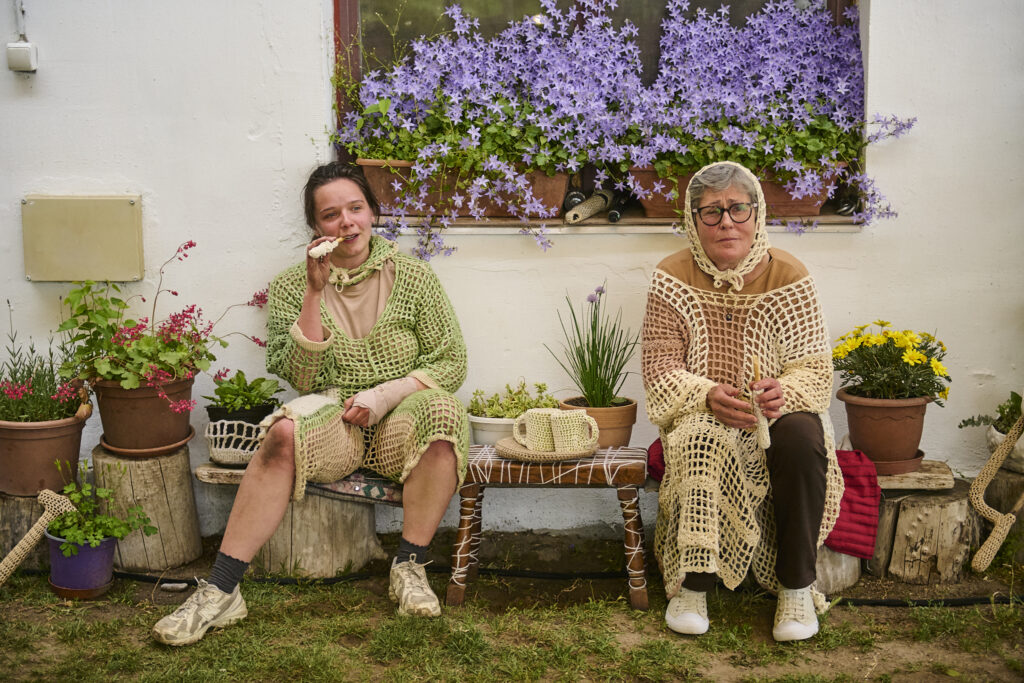
Concept, choreography, performance, costume, music: Zsófia Szász
Performance by: Katalin Kisapáti, Zsófia Szász
An alternative version of Softloneliness, created for the PerformnaszBusz program of Trafó House of Contemporary Arts.
Terpsichore and Annapurna are old friends. There is no age difference between them, for they are both older than humankind itself. They live far apart. Annapurna cooks; Terpsichore dances. Yet once every century, they meet again. When they do, they simply spend time together. They can never be certain that they still understand one another. It would be difficult to relearn, every hundred years, the language they both speak. For a while, they made the effort, but by the twenty-first century, they had grown tired of it.
Now they meet for one reason only: because they are part of each other’s lives.
Performed at: Trafó House of Contemporary Arts PerformanszBusz Bordány
Premier: .08.03.2025. NEXTFESZT Trafó
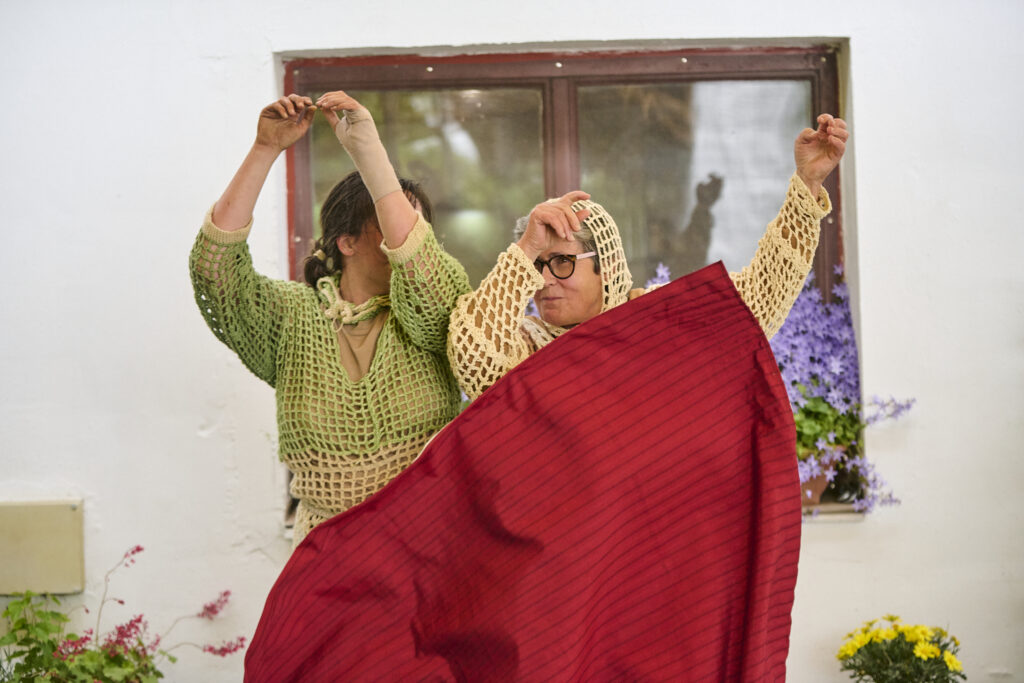
Adaptation
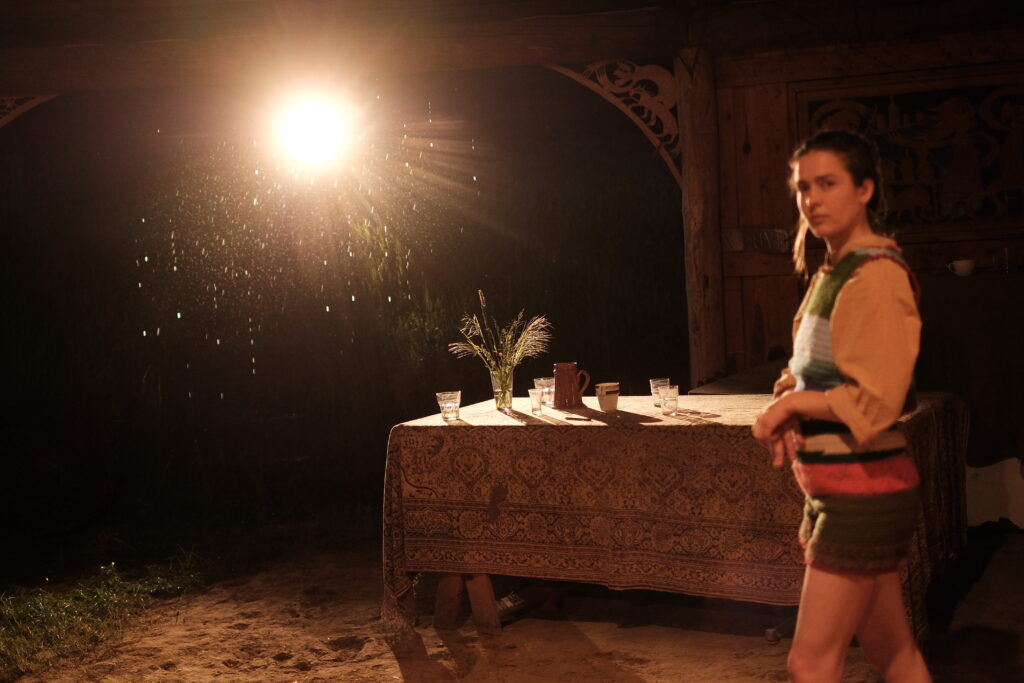
A dance performance made in 2021, and its movie version
concept: Zsófia Szász
creators, dancers: Katalin Bitó, Miklós Paizs, Zsófia Szász
Film version by: Szabó R János, Kőrösi László
costume: Zsófia Szász, Katalin Bitó
lights: Kristóf Früchwirth
Supported by: Hungarian National Cultural Fund – Zoltán Imre Program, Workshop Foundation, SIN Arts Center, Katlan Group
In this piece, folk dance becomes a unique passage through time, where past and present meet within the bodies of the performers. By abstracting time itself, the three performers become archetypal figures. Everything becomes symbolic, while at the same time remaining reduced to its simplest form.
Premier: 2021 MU Theater Online, 2021 Artus (live)